

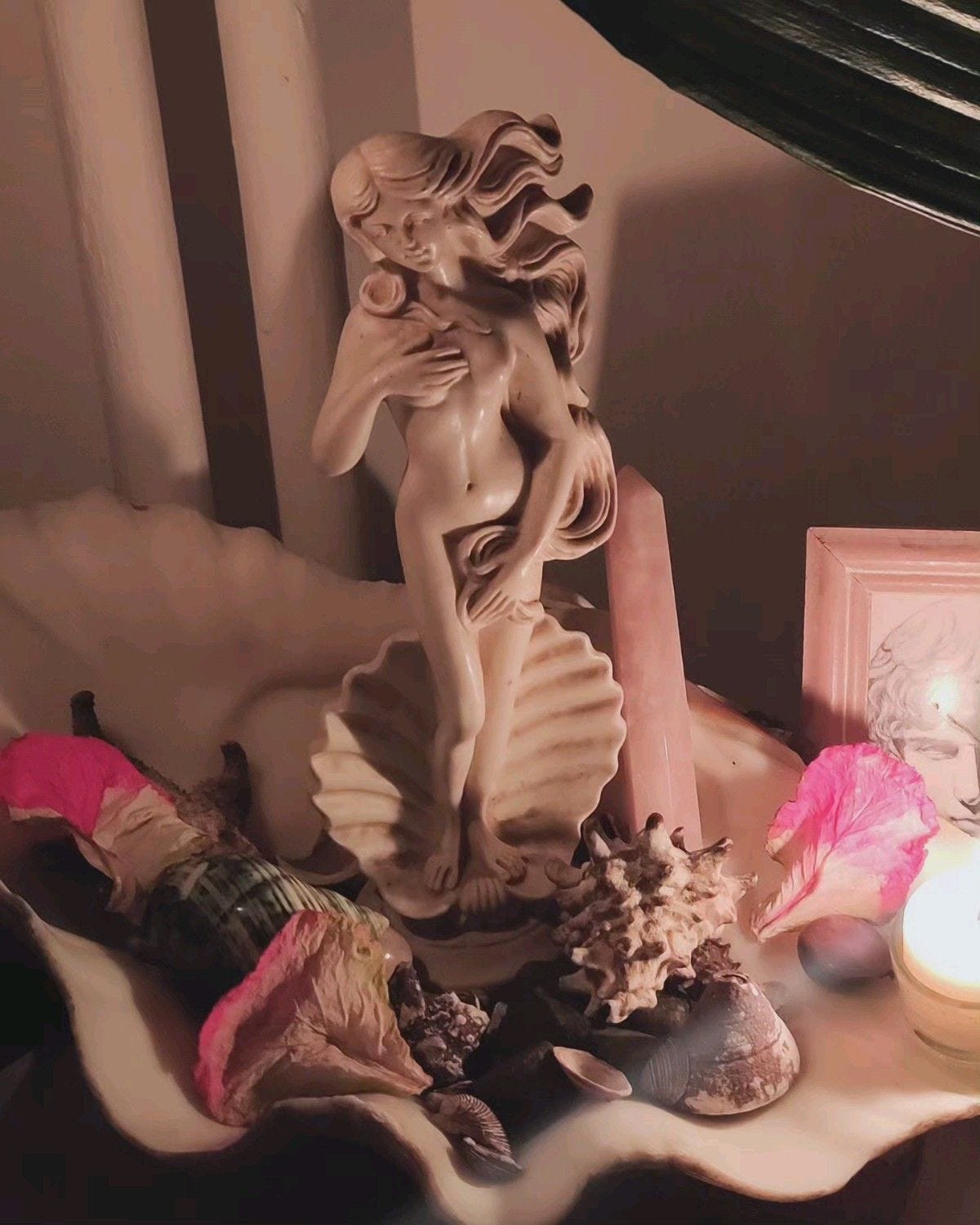
“And then I became almost an idolater: I acquired a statue of Aphrodite, to which I burnt incense and brought flowers every morning.”
Besides all its problems, Milan is considered the “gay haven” of Italy, with the whole neighborhood of Porta Venezia dedicated to the Queer community. So it shouldn’t be a surprise to me that there is also an entire book store dedicated to Queer and Feminist literature.
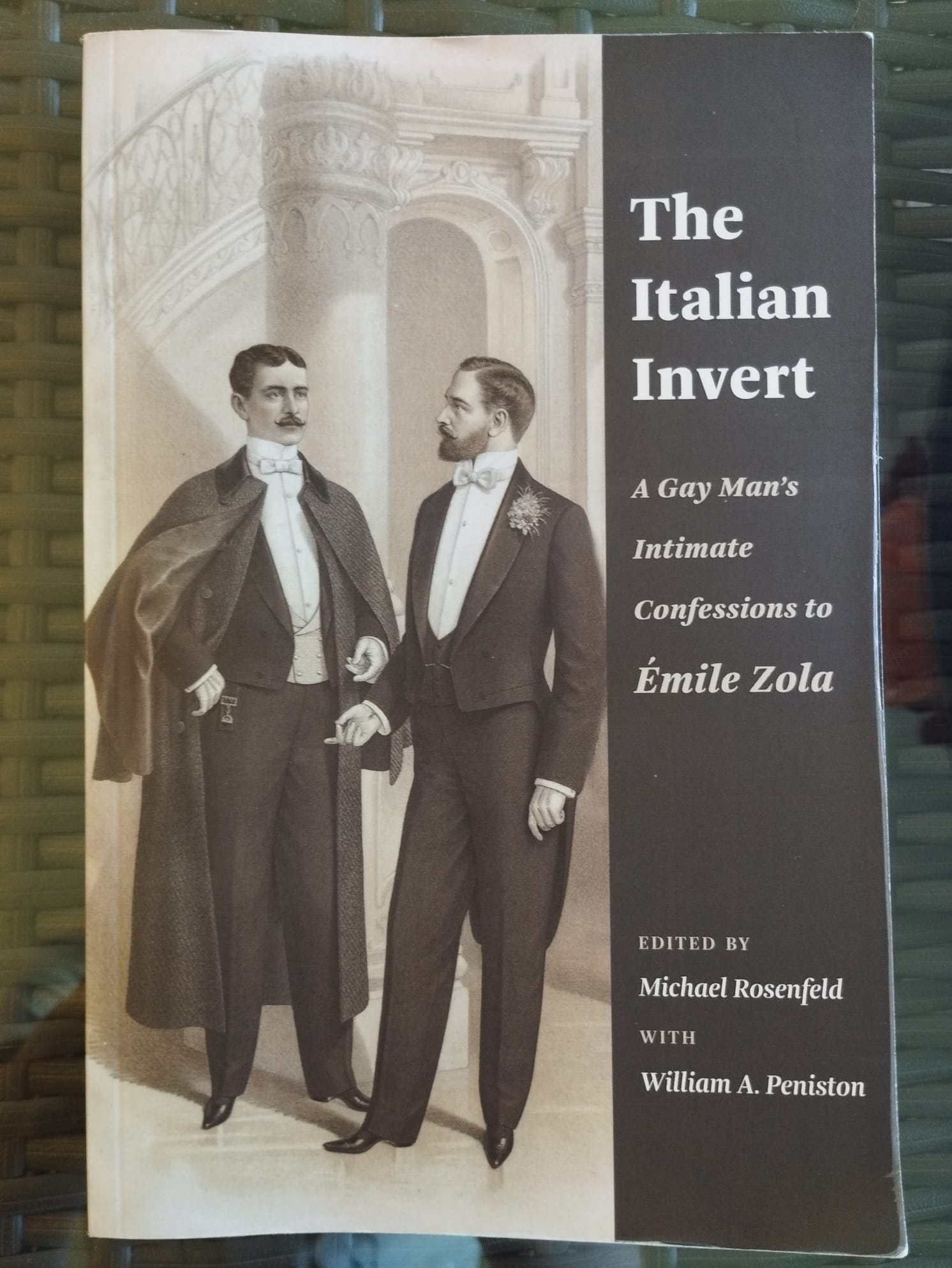
If I decided to write a Substack for every book and subject one can find there, and how it relates to Queerness, from fashion and art history to poetry, literature, cinema and political science, I wouldn’t have the time to write about anything else. So for now I will focus on a particular book that I found there: The “Confessions of an Italian invert to Émile Zola”. (Or confessions of a homosexual if we make a literal translate of the title in the Italian version.)
As I’ve written on this note, the book offers great insights on the Fashion and elements of gay social customs of the time, and some behaviors that we can even see among gay men today.
Comprising a collection of anonymous letters, written by an Italian noblemen to the famous French writer Emile Zola as a form of a confession and liberation. A way to offer himself to be studied (a touch of narcissism that is very easy to grasp by his letters) and find an explanation for his condition. Which in the end, turned into a celebration of his sexuality, vanity and aestheticism.
The male figure
I love the most serious, correct and masculine elegance: The English chic.
Our anonymous aristocrat brings us to 1889, during the reigns of King Umberto I of Italy and Queen Victoria of the United Kingdom. Although there is no clear indication of who he is, we do know that he is from a minor noble family from Naples, and mentioned that his grandfather married an English noblewoman. This marriage was the introduction of the Anglomania in the family, and had a direct influence on his fashion sense.
“I enjoy the correct and straight chic of the English, from which we follow all the simple and singular fashion. I love the black, which enhances my blond and gracious image. I also enjoy the most interesting shirts and undergarments and the most elegant and fashionable boots”
A direct quote from the book, with a rough translation from Italian. It shows us not only his (low-key obnoxious) vanity, but also an idea of the menswear of the time, specifically the English. Or at least, the idea of how it was perceived by an Italian nobleman.
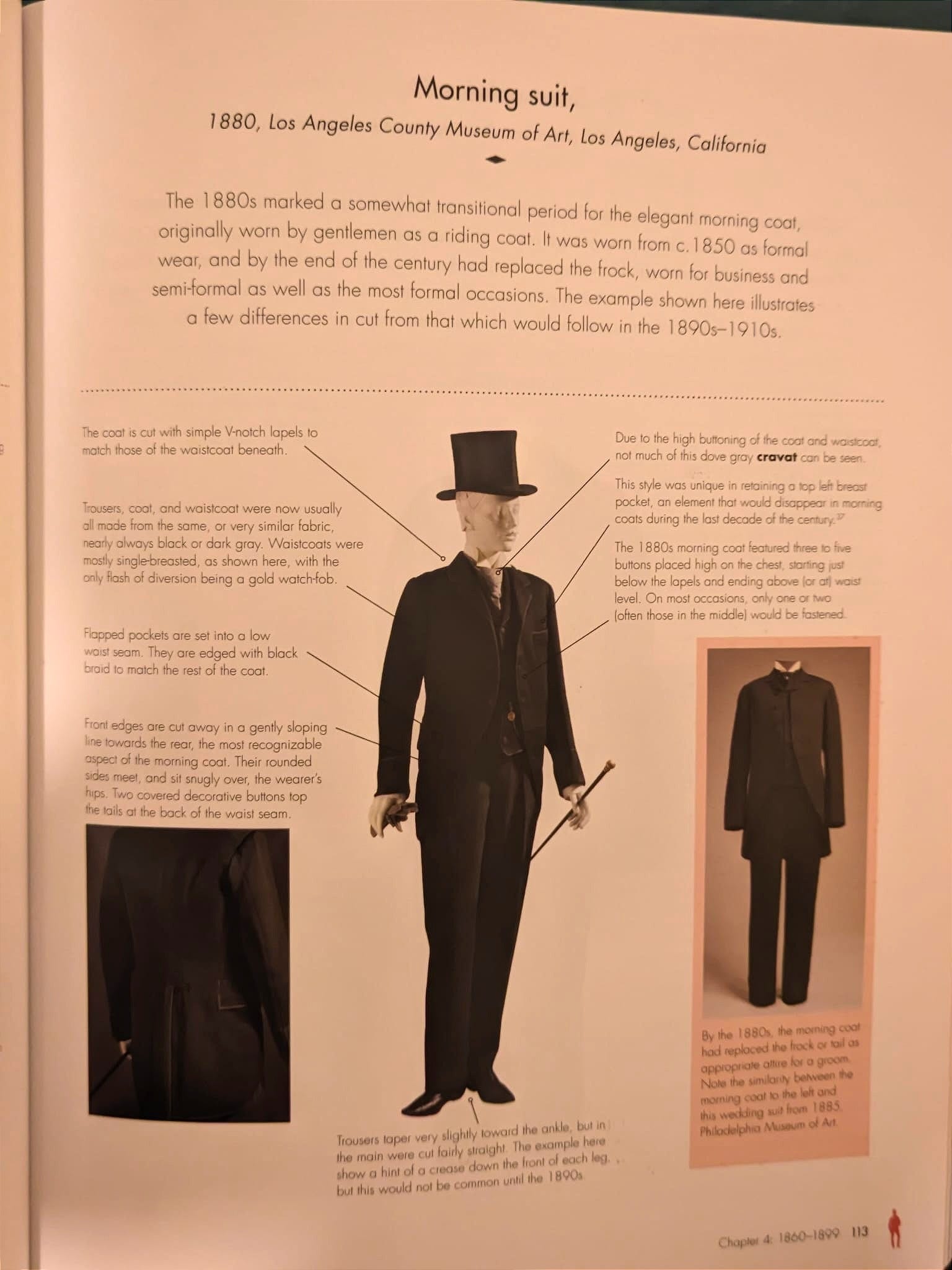
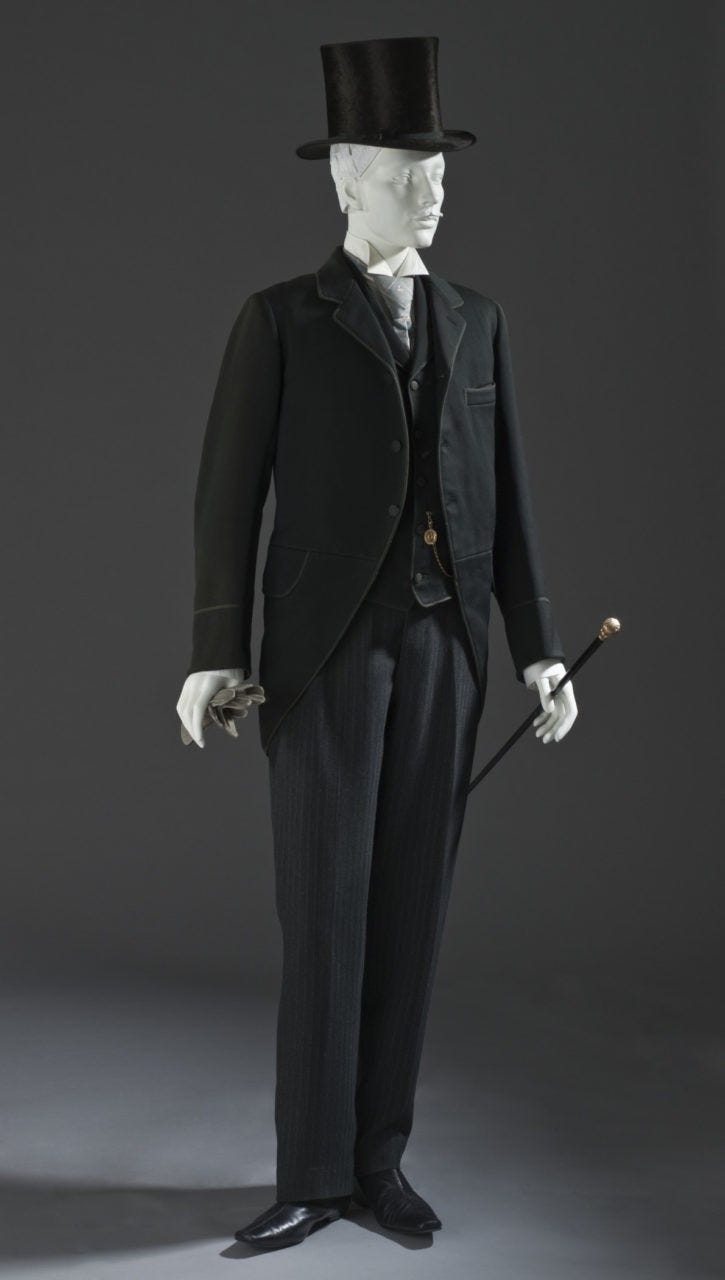
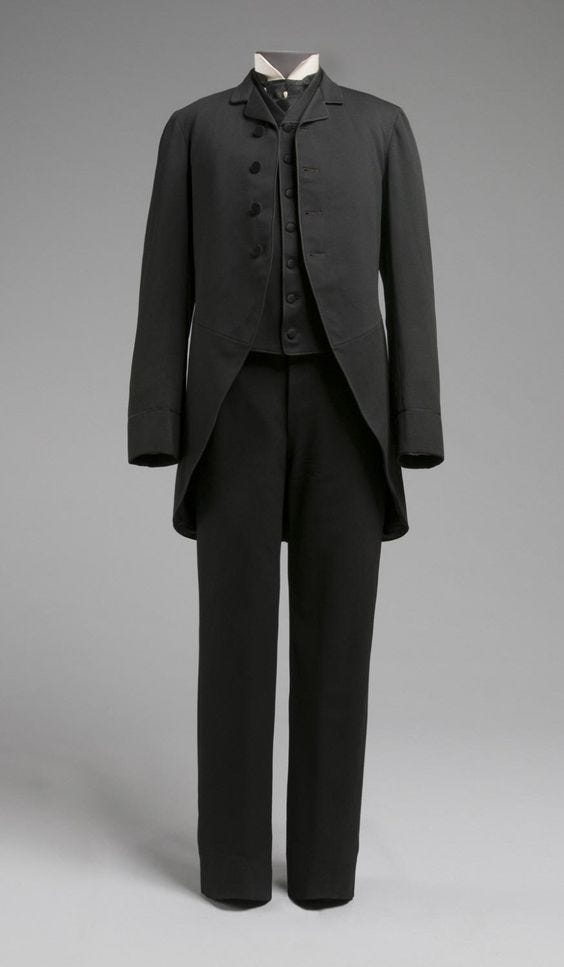
Already entering the 90’s and following the English fashion, he probably would be wearing a morning coat in a matched three-piece suit, all in black as his preference. The morning coat was originally worn by upper class men as riding coat, but by the 50’s it had replaced the Frock as the preferred formal wear.
Combining some research with what he says in the letters, I believe his morning suit to be made as it follows:
Matching V-notch lapels for both the coat and waistcoat
Single breasted waistcoat, made with the same fabric as the trousers and coat. Usually black or dark gray. It could be decorated with a golden watch-fob that our Italian aristocrat probably used.
The edges of the coat are cut as a soft and fluid line towards the back, which was the most iconic aspect of the morning coat, together with two decorative buttons on the back.
By the 90’s, the hem of the trousers would have a crease down the front of each leg.
A cravat. Usually gray or blue.
The morning coat would have three to five buttons.
A hat was usually part of the outfit, although it was becoming more reserved to formal settings with the times.
Cuff links and cravat pins could also be worn as part of the outfit.
He also mentioned his use of the Mosche(wasps): Small fake skin moles, that were usually made of cloth.
The Aesthete
“I enjoy everything that is Beautiful, and nothing is Beautiful enough to my eyes…”
Throughout the letters, the anonymous aristocrat shows a characteristic that is common to many queer people: The desire for Beauty and a Passion for the arts.
By analyzing more of his quotes, and my own experience as a queer creative, the answer for this sensibility might be on the very oppression and emotional distress we feel while growing up.
…I desired and called for death, in the horrible solitude that I was in…
…And why should I be ashamed for what I have done? Wasn’t Nature’s first mistake to condemn me to an eternal sterility.
All of my thoughts and excitements were dedicated to the Heroes… I still remember the sweet emotions on those long moments passed on the Museum’s corridors, where I could see the beautiful Heroes and naked Gods.
Even though from time to time I torment myself with laments for not being men enough or a woman. I enjoy comparing myself to the mythical Heroes, and that Hyacinth and Ganymede were not different from me, and were loved and adored by the most powerful and beautiful Gods.
In my experience, many queer people become very introspective because of the suffering from the outside world. We start to look within, and be more aware and open to our feeling and emotions (regardless of how dark they can be). We also start to look for places that we might feel safe, so our sensibility leads us to a world of Beauty. Where we can see our love, desires and identities made manifest through the lens of art.
The shadow
I don’t feel the need to put the exact quotes from the book, as they might be triggering for some people (something to also take into account before picking up the book).
In his letters, the anonymous aristocrat makes many remarks that are problematic to say the least. We can see misogyny, internalized homophobia, some form of what we would call transphobia today, racism, antisemitism, classism and elitism.
They might offer a tool to study the culture and mind of the time, as I don’t think his contemporaries were much more tolerant than him, but these aspects of his letters and thought can offer us a reflection that many gay men and other marginalized people need to make: Being part of an oppressed group does not exclude you from participating in other forms of oppression.
Unfortunately it is not uncommon to find gay men expressing and defending ideas that go against our own broader community, especially those who can pass as the ideal hyper masculine white male. It’s a phenomenon that it’s still present today and has been part of the gay community since forever.
(The book ‘Faggots and their friends between revolutions’ (mentioned here) explore this struggle between faggots, fairies and lesbians against the empire of men, of which some queer men were complicit.)
So may we always search for Beauty, through fashion, art and pleasure. But also through community, healing and acceptance, so we may finally dissipate the shadows.
Love is One, and One is All
References:
“How to read a suit” by Lydia Edwards
“The perfect Gentlemen” by James Sheerwood
“The Italian invert - a gay man’s confession to Émile Zola"