

Barefoot, wild and free. With a yellow band on her waist, she unties the love knots. Freeing herself from any social bond and rules.
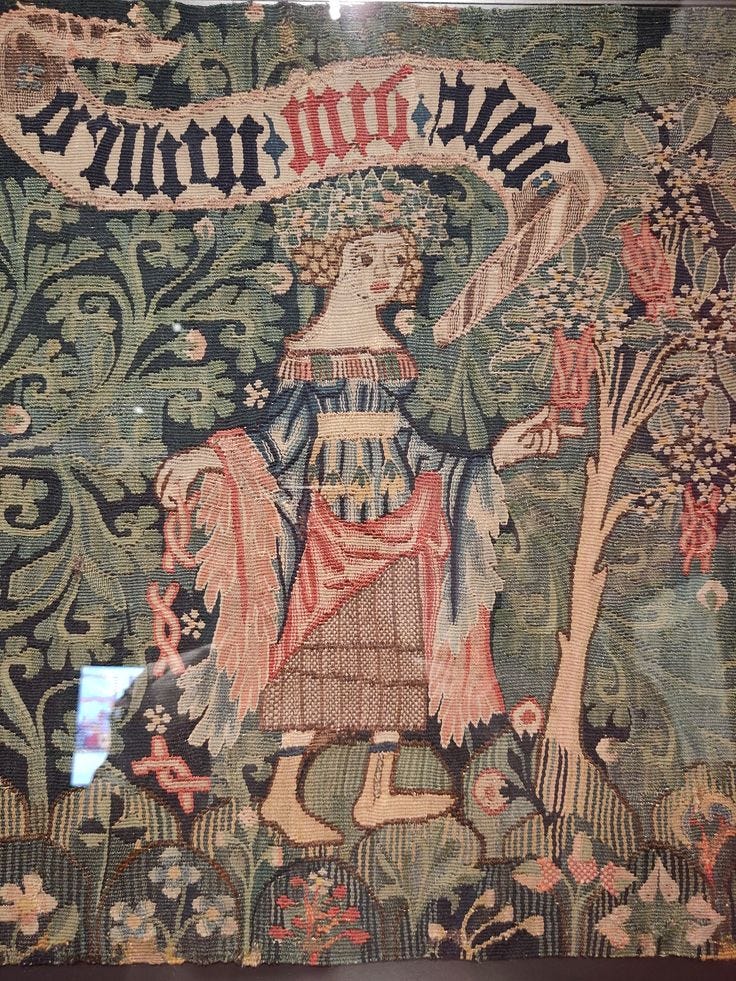
“Mit vir der Wellein” (Meaning “with your consent” in old German) is written in this brothel pillow case found in Basel in the 1400’s. I had the privilege to see this piece in an exhibition in Zurich (mentioned here) that I visited over a year ago.
In the scene, we can see a prostitute with a flower garland on her hair, a flowing dress and a yellow band on her waist, untying love knots from a tree with our consent, as she says. A provocation, as regardless of how she is seen and how marginalized she is for her ‘crimes’, she can only perform her deeds by the request and desire of the righteous men who throw stones at her.
But how do we know that she is indeed a sex worker? There were many dress codes, laws and signals regarding clothing in that period, and wearing a yellow waistband was one those. This knitted wool piece shows how they were viewed as deceivers, untying love knots symbolizing the sanctity of marriage. The yellow band was symbolic because the color was a considered a symbol of deceit, infidelity and treachery, and often used in art to represent characters related to it.
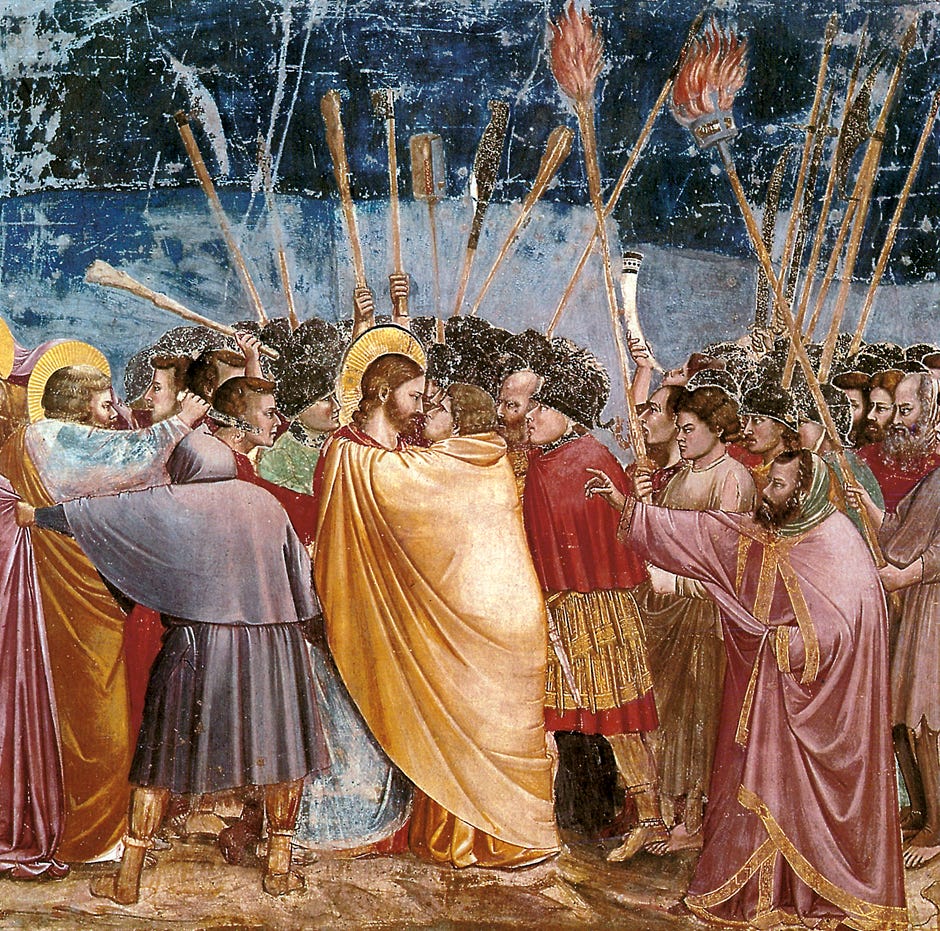
This affresco shows the “Juda’s kiss”, at the Capella degli Scrovegni, in Padova, Italy. Painted by Giotto, it shows the most famous treachery of Christianity, and even in her, the yellow mantle was used to dress Judas as the traitor.
In another Affresco, we can see Judas selling himself to the Devil, accepting the silver coins as a payment for his services.

But the presence of a yellow band was not the only instrument used to signal the virtue of a woman as already from the late 1200’s, a series of laws regarding dressing were put in place.
They varied, concerning the length of the dress, how colorful it could be, and how many jewels and stones could be used to decorate the garment. There were also a number of limitations on textiles, where elaborated patterns and materials like silk were forbidden. The idea was not only to promote modesty against indecency, but also to suppress any expression of individuality.
Social class and different stages of life played a role on what one could wear or not. Most noblewomen were allowed to wear more expensive and detailed textiles and jewelry if the cut of the garment itself was modest enough, while unmarried young women were allowed to be a bit more ‘extravagant’ as a way to call the attention of potential suitors.
With time, the pursuit of modesty went hand in hand with social stratification, with the introduction of taxes and fines for illegal garments. In Florence, one could simply pay a fine, mark and declare their piece of garment, then they would be good to go. A luxury that lower class citizens couldn’t afford.
So, a summary of Tuscany’s Sumptuary laws:
Textiles: Too many colors, patterns and decorations such as embroidery, stones, pearls and beads were forbidden, along with fibers like silk. Not only women, but also men were allowed to wear one or two colors in the same outfit while simple and geometric patterns were allowed. Embroidery pieces were allowed, as long only the hems were embroidered, and no gold thread was used.
Headpieces: It was a custom of the time to make braids intertwined with cloth stripes. Naturally, silk, pearls and jewelry were forbidden and the look needed to be the most modest as possible. Head garlands were also allowed, and often were used as a way of styling without catching the attention from legislators.
The undershirt: As it was an underwear, it wasn’t contemplated by the regulations, as it was a given that were supposed to be hidden. They were usually made of cotton or linen.
Giubba: It was worn write above the undershirt, but it was still considered to be an intimate undergarment. But the presence of legislation to regulate how they should be made indicates that there were moments when they were supposed to be seen in certain contexts. The pieces could be bi-color, divided in half or striped.
The tunic: Also called Gonnella, the first piece to be worn and seen, it covered both the Giubba and the Undershirt. It could be worn both on a domestic or elegant environment. It was a long piece of dress, following the measurement guidelines, with no waist line and very fitted sleeves. The sleeve buttons should be sown in a straight line, couldn’t be made of gold, and if silver was used, it had a weight limit. The number of buttons also couldn’t surpass the elbow.
Guarnaca: Almost like an ‘over tunic’. It was worn over the Gonnella, and had larges sleeves so the ones from the under tunic could be seen. Both pieces were usually worn with matched fabrics, or with a two-color contrast.
The mantle: It was one of the most important pieces to indicate statues and social class of the woman wearing it. Unmarried woman could wear mantles with simple ornaments and decorations (always avoiding pearls and too much gold and other precious stones), and using fur as lining was also forbidden.
Footwear: There aren’t many rule regarding footwear, as they were supposed to be hidden by the length of the Guarnaca, with the exception of places like Florence, where decorations such as embroidery and leather-carving were forbidden. The general rules regarding footwear were more related to the erotic nature the feet had to them, as it was forbidden for shoemakers to touch a woman’s feet.
Fur: Artisans needed a license to work with the most precious fur such as stoat, which the use was also reserved to member of the higher class, such as nobles, doctors, knights and lawyers and their wives.
Belts: As usual, precious materials like silver threads, gold, jewels and stones were forbidden, and there was a weight limit on the belts that could be worn. Teenagers and unmarried young woman were allowed to wear more decorated pieces.
Bags: Small bags attached to the belt or gonnella usually had the same restrictions as the belts, regarding the presence of precious materials and decoration. But women in general were not supposed to wear them, as shown in most artistic representations, they were usually reserved for men.
Gloves: A symbol of power, they were reserved to member of high society, as long as they were not made of silk. Interesting enough, prostitutes were also obliged to wear white gloves as a sign of recognition. For that reason, women that were not outcast from society usually wore blue gloves.
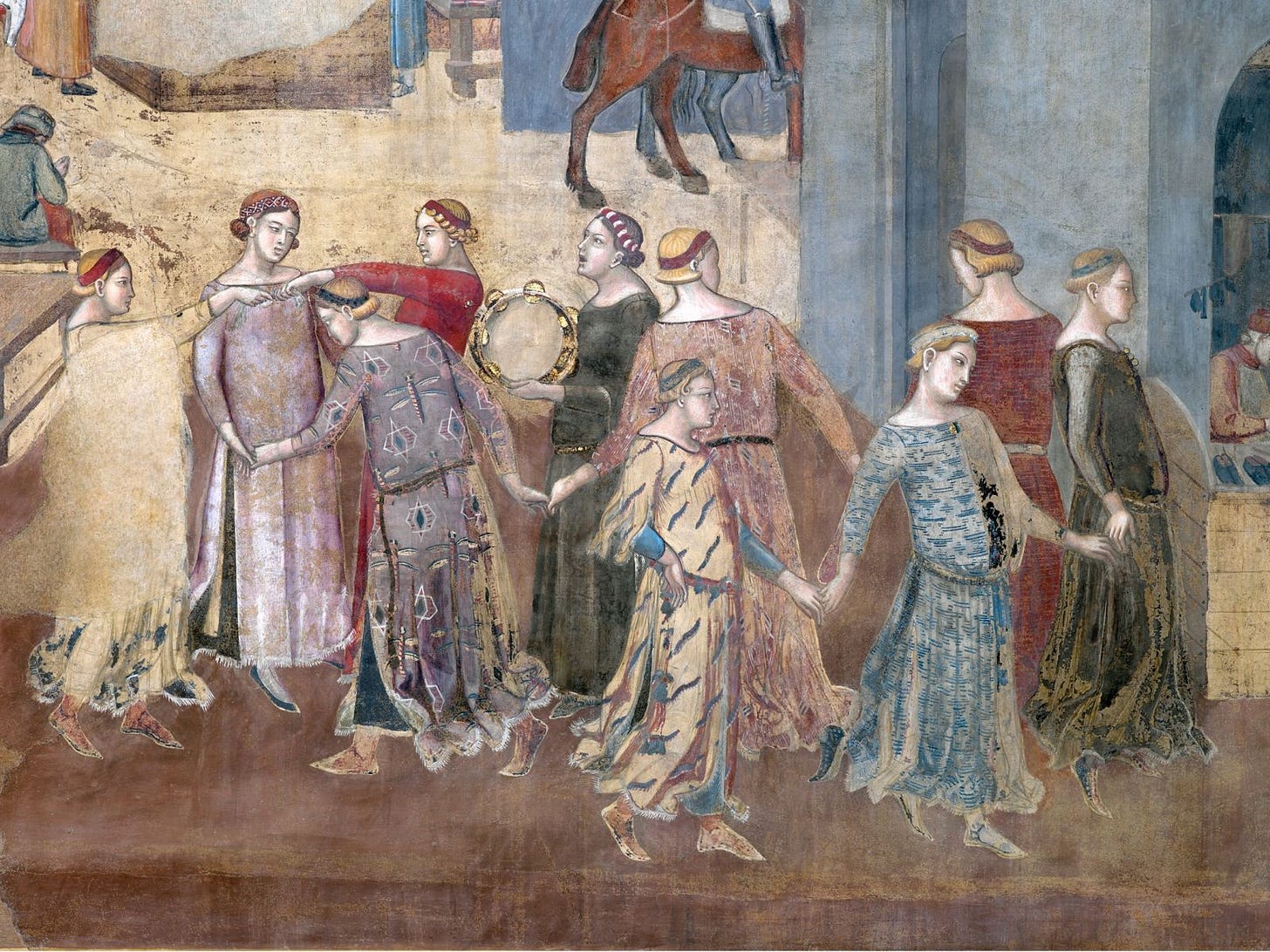
Details of the “Allegory of Good government”, showing what was considered acceptable for women to wear: Simple prints and colors, a long Guarnaca covering the body, and sometimes showing the sleeves of the Gonnella in contrasting color, and head pieces made of braided cloth stripes.
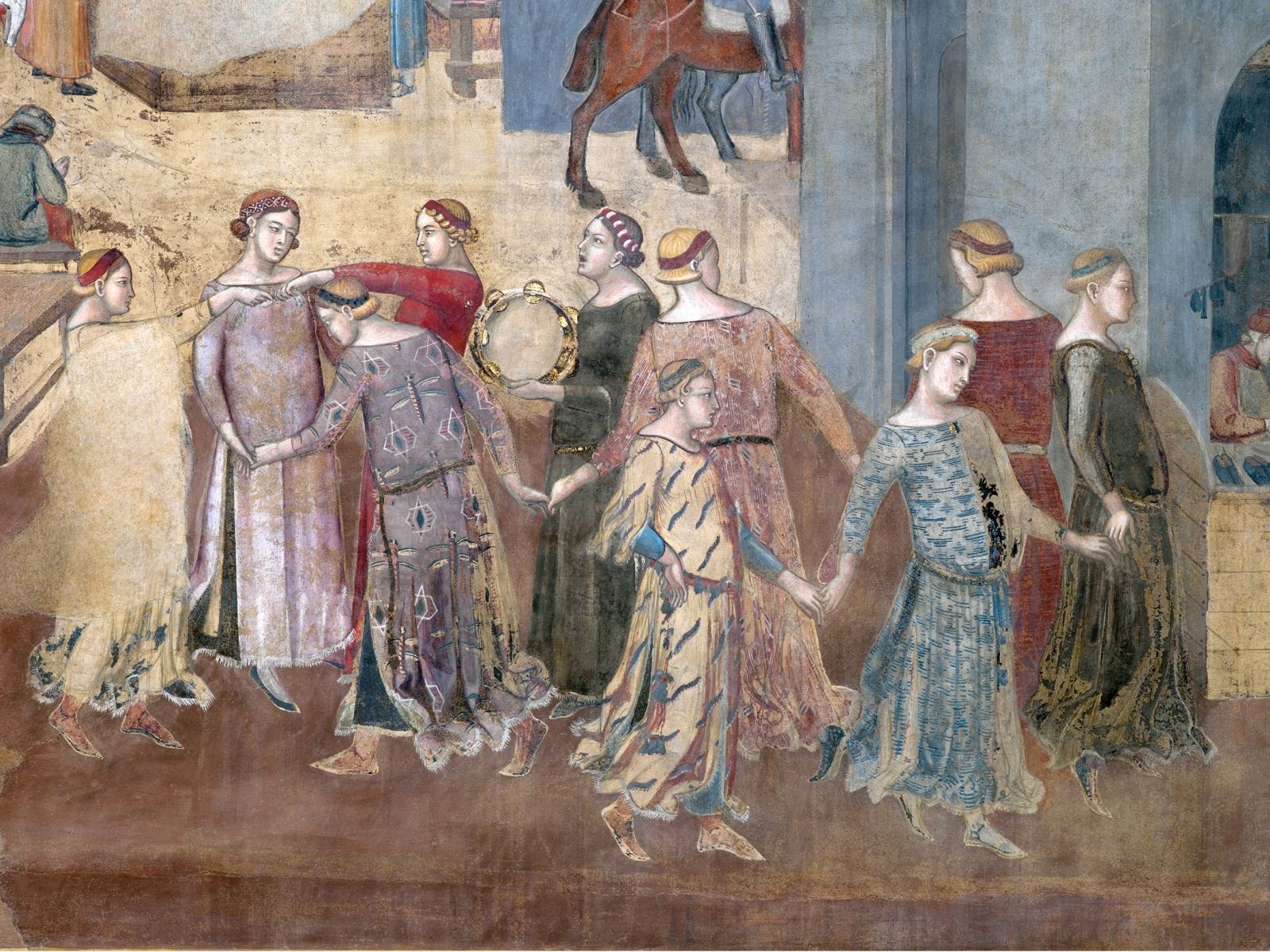
As mentioned before, all of these rules could be avoided by the noblewomen and wives of lawyers, doctors and knights as long as they kept the desired standard of modesty. And with time, most of the Sumptuary laws turned into a way to raise funds and taxes for the State, being less about morality and more about who can ‘flex’ their status.
In this scenario, prostitutes were in a particular position. In some places in Tuscany they were indirectly allowed to be as extravagant and lavish as they could afford, as by being prostitutes, they were not even considered worthy of being regulated by society’s virtue based laws, but were required to wear some identifier such as white gloves and yellow scarves sometimes. The relationship of Yellow color and the lack of morals, with the yellow band or scarf, was kept in most of Italy and German speaking countries.
Other European regions had their own identifiers and regulations, like in France and England, where they were forbidden to wear jewels, fur or other ‘respectable’ garment pieces. Caps and Striped hoods were also a common piece for prostitutes. In Milan they wore black cloaks, while the striped hoods were common in Britain. Switzerland was a particular case, as we have art showing the usage of the yellow band (see the tapestry in the beginning of the post), but also the presence of red caps in cities like Zurich and Bern.
Most of my references for this piece are from the past exhibition “Bodies in the middle age” in Zurich, and from the book “Moda a Firenze e in Toscana nel trecento” (Fashion in Florence and Tuscany in 1300) for those who can read in Italian :)
But the Sumptuary laws are a vast subject, with a lot of regional and chronological variations. So I hope you enjoyed this small summary, and that it might inspire you to take your research further.
Thank you for reading, and let me know what you think.