

The Weave is a section of my publication where I explore aspects of fashion and costume history, and how they relate to the way we see and consume fashion today, with a special focus on material culture, craft techniques, sustainability, menswear, and queer masculinity.
This piece briefly explores the evolution of menswear. From the lavish court dresses to the austere man of today.
We have all seen this phrase shared online, especially with the rise of conservatism, where there is this idea of a lost masculinity threatened by a so-called woke culture.
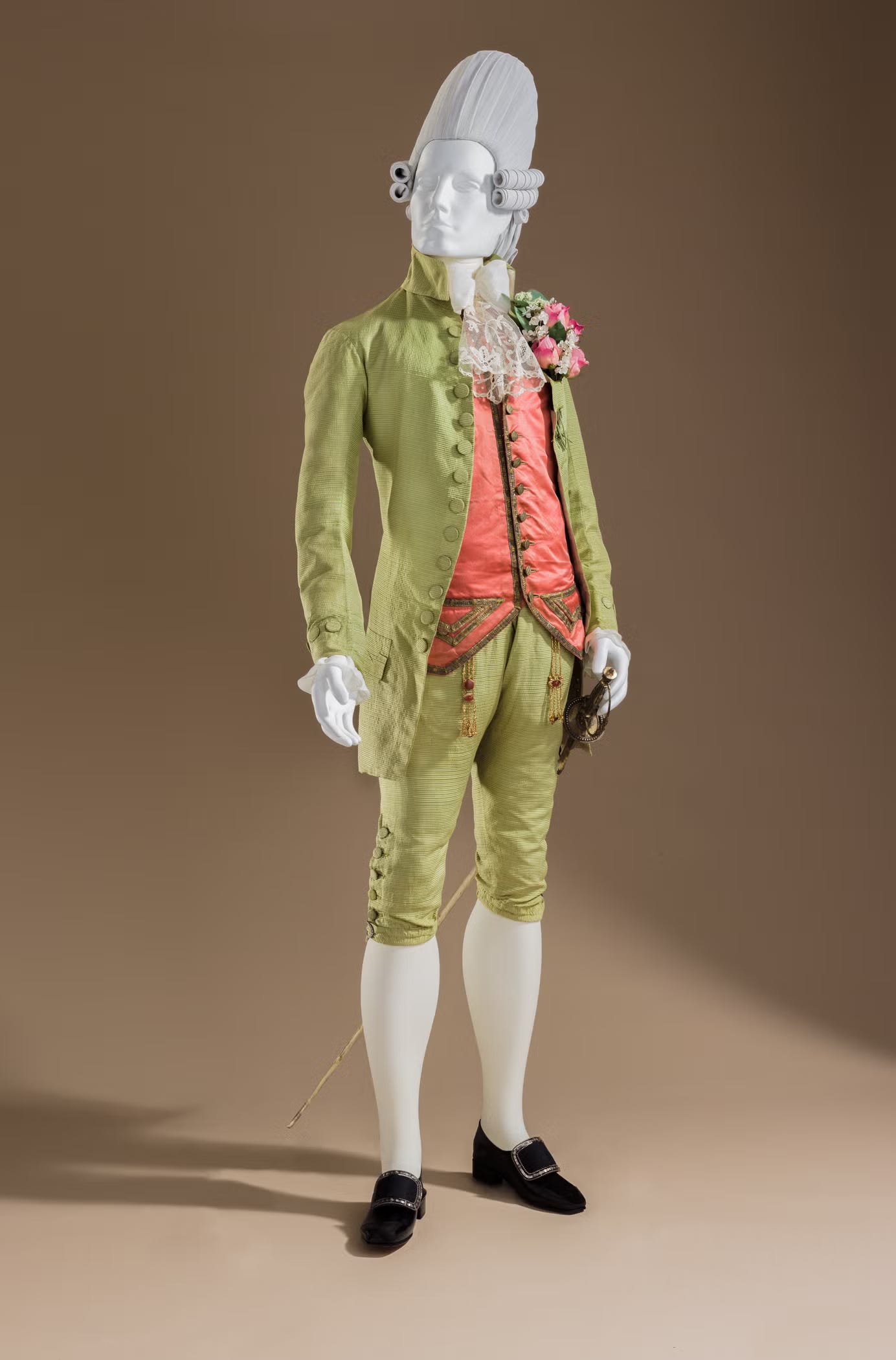
More liberal people will rightfully respond to that by pointing out the 17th-century men’s fashion, with flamboyant fabrics, embroideries, heels, make-up, wigs and many more elements that we consider feminine today. While conservatives will then counter that this style was exclusive to the aristocracy and didn’t reflect what ordinary men actually wore.
Both sides usually miss the context of when, who, where and why
As I mentioned before, this is the period of time that people refer to when they talk about the flamboyant menswear, and for a number of reasons that I discuss here, it was also a period where we can see an increase of material possessions and the production of goods. The seeds for the fashion industry were planted, with the development of new fabrics, motifs and techniques in the chain of production. Fashion wasn’t yet accessible as it is today (and we can discuss what accessible means anyway), but common people who were engaging in commerce, and therefore increasing in wealth, began to have access to a system that allowed them to dress a bit like the nobility, and besides that, renting and buying second-hand clothing was actually not uncommon back then.
In France there was this race between the old nobility and the new bourgeoisie, with the latter trying really hard to approach the style of the aristocracy, while the nobles searched for even more extravagant and expensive materials to differentiate themselves from the common people. The height of this race was with the court of the Sun King, where France was finally consecrated as the center of European fashion. The style, extravagance and trends decided in Versailles soon started to dictate how the rest of the continent would dress in what some authors called a trickled-down fashion system: What was decided at court would pass to other nobles, which in turn would influence the Parisian higher class, and then merchants, workers and servants. Until it reached the countryside and spread across Europe.
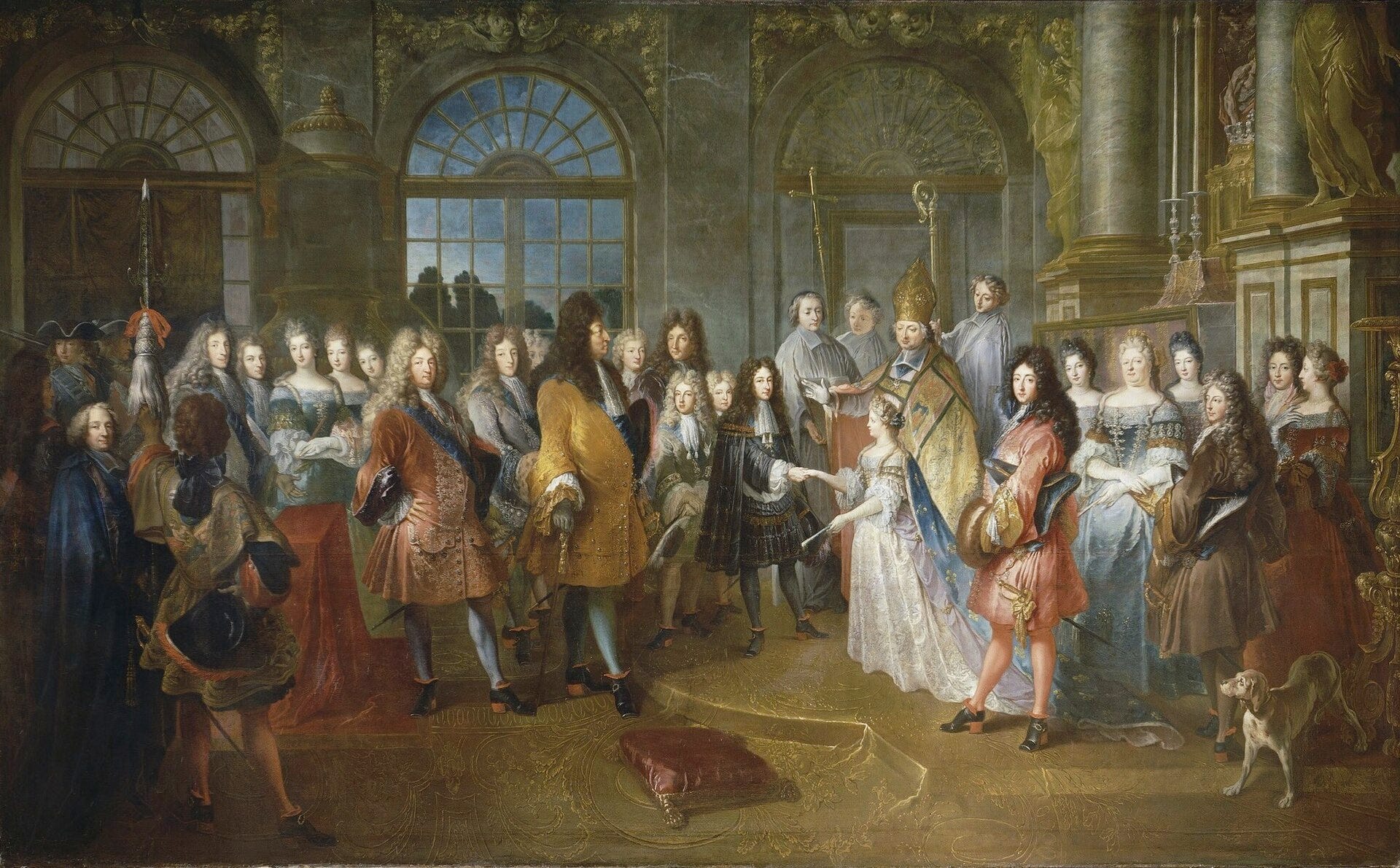
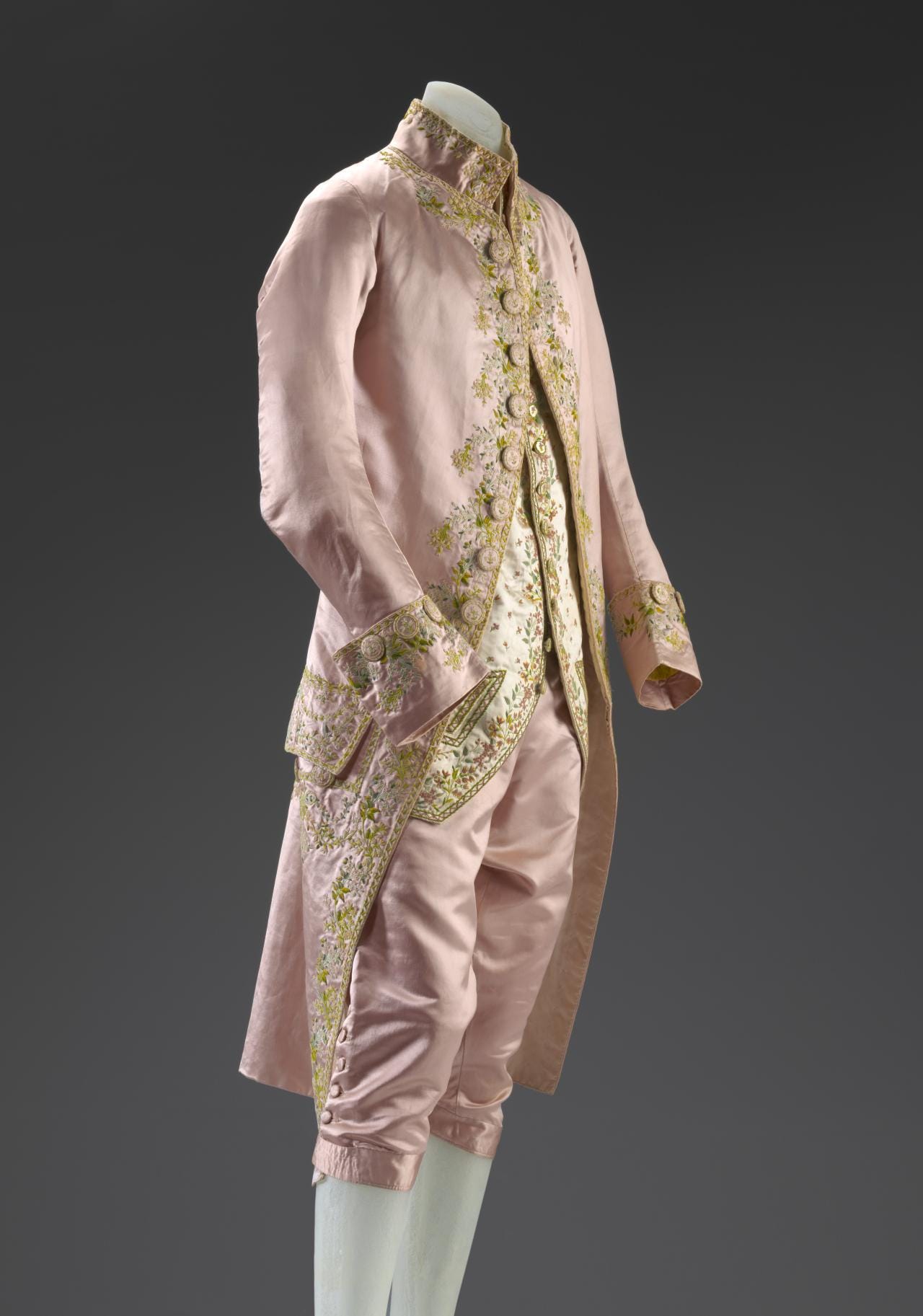
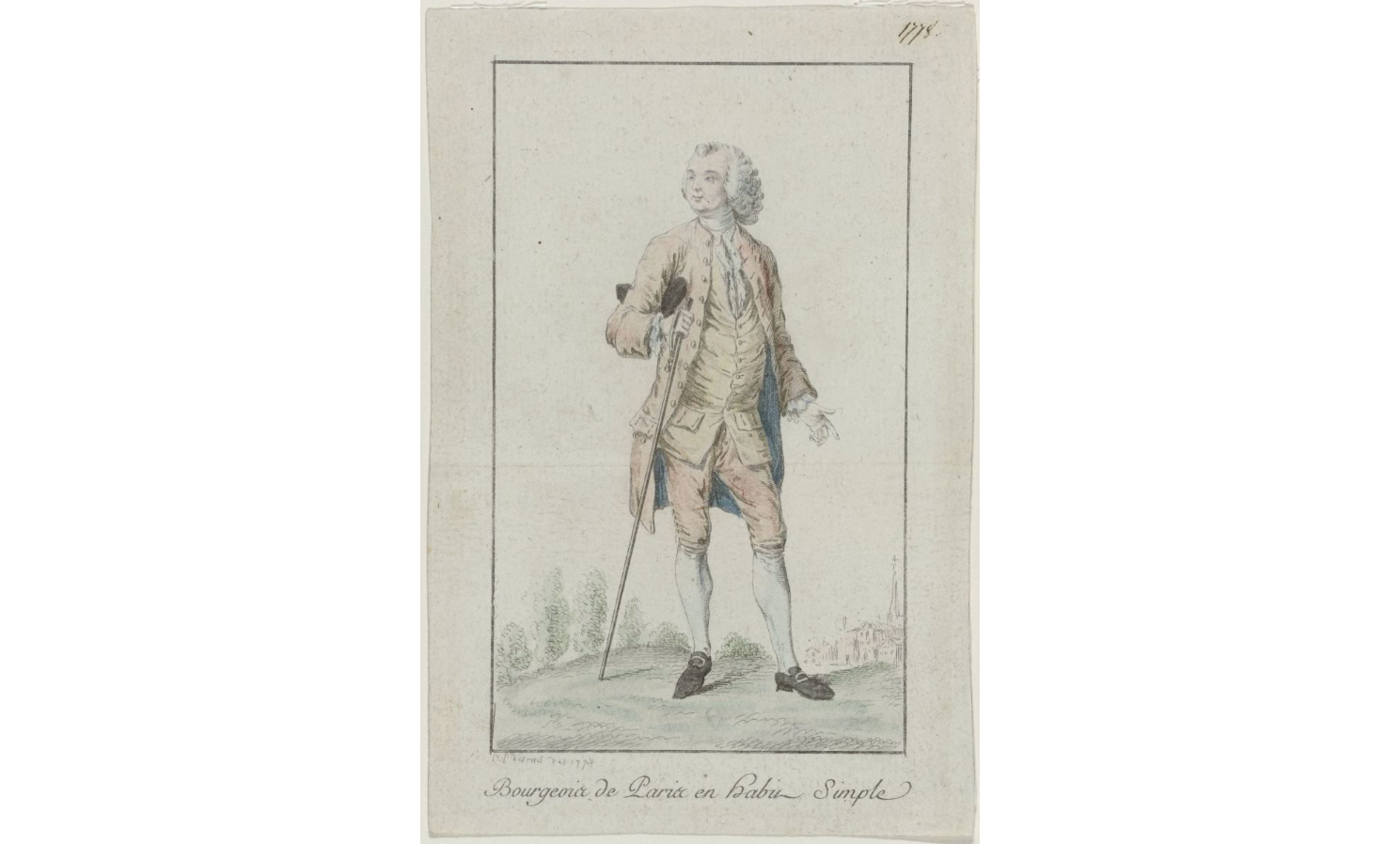
In England on the other hand, always at odds with France, fashion was used as a political tool. Republican puritans would soon use the lavish catholic court from the continent to criticize their own Monarchy. This would bring the preference for the minimal and austere style of the English men. It was also a way to protect and boost the local economy, to convince people to buy English clothing made of English materials instead of the cotton and silk brocades from France and the rest of the continent.
“What application is there to all this in my poor England? If not only the swords, the gowns, the great wigs, the boots and breeches of the men, but even the cloaks, the petticoats, the laces, the shoes, the caps, are products of that country? If no young man can be chosen from the sons of our yeomen or gentry to be a footman to our Lords; if no hand but that of a Frenchman can be used to trim or shave our beards? No cut but that of the French tailor to shape our textiles; no language but French to be articulated by our tongues; no religion but French to satisfy our souls. I pray you—where shall we end?”
- An anonymous letter written in 1683.
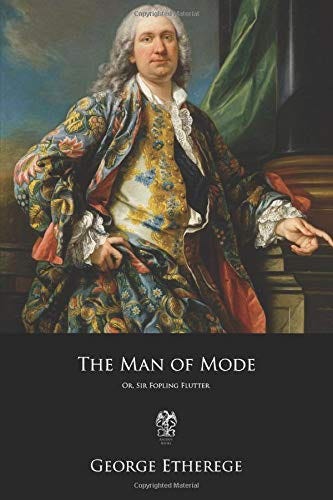
The excesses of the newly emerging French fashion were now seen as a Trojan horse: A way to corrupt the moral integrity and virility of the English (we can see a similar discourse being made today), and soon the culture of the time would create narratives to counter the growing influence of the French. France was often called Madame la Mode and cultural productions of the time, mainly comedies, would include a stereotypical English man who fell down to the vices of French fashion. The most famous example is the Man of mode, or Sir Floping Flutter:
Medley - There's a great expert on the subject, I hear, fresh from Paris.
Harry - Sir Floping Flutter, you mean.
Medley - Yes, he is.
Harry - He thinks he's the paragon of modern elegance.

Emilia - He only wears original pieces from the most famous Parisian designers.
Sir Floping - You guessed it, ma'am.
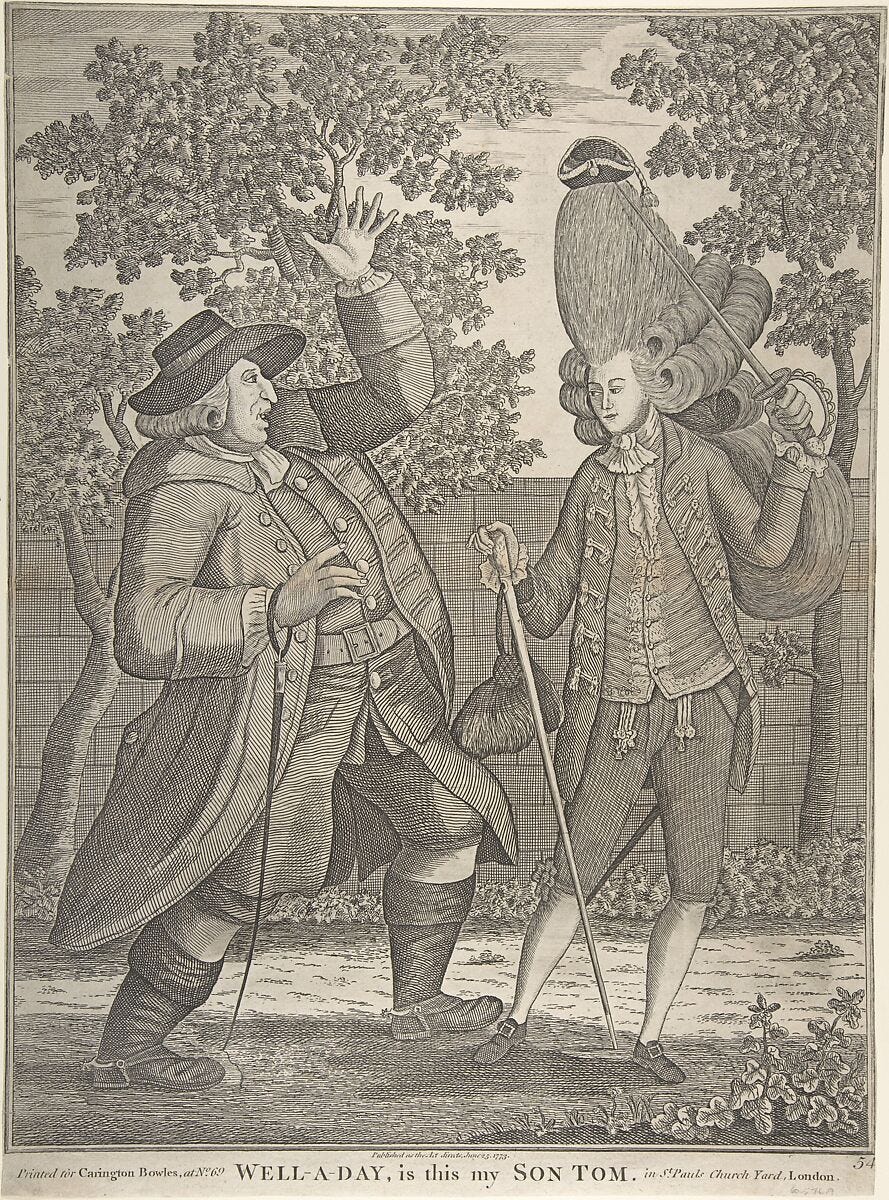
But the Puritans were not the only ones to recognize Fashion as a powerful tool of propaganda. If the conflict in the beginning was between the Puritanical English republicans and the Lavish French Catholic Court, the British crown also started to use Fashion as a medium.
The main criticism by the Puritans was the culture of excess that was related to the Monarchy and Court culture. With that in mind, Charles II of England from the House of Stuart revolutionized the court dress. Retiring the doublet and hose, he introduced the simple vest and coat, the forebears of the modern 3-piece suit. The new court dress abandoned all the laces, ribbons, embroideries and complex fabrics from the previous period, and cutting the English court from any influence from the French style. It was also a way to promote the English production, as ‘vest’ could also mean simply any garment made of wool.
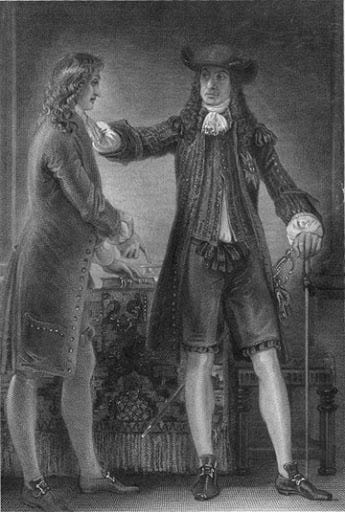
But there was a contradiction: The French style was indeed more popular, faster and elaborated. But because as it became more popular, many new techniques were developed to reduce costs and time of production: Smaller motifs, fiber blends and the beginning of what would become the standard sizes. The English style on the other hand, although simpler and austere, the quality of the fabrics, weaving and stitching was often superior.
The Abbot Le Blanc used to say that the modesty of the English style was only in the appearance, pointing out the luxury and high quality of the materials and production. Because of this combination of quality and sobriety (maybe what we call quiet luxury today?), and the narrative of the defence of the male morality and virility, the figure of the tailor grew in popularity, as the ‘maker of the male image’ in English society.
For years, if not decades, both systems would develop in parallel. For some time, the French style remained the favourite for both men and women, with the development of the first fashion magazines and figures like the Merchands de modes, basically the ancestors of the modern personal stylists, that helped to consecrate fashion as an important part of French economy and cultural identity. Until the fall of the Ancien Régime, and the rise of the Enlightenment, that promoted the ideal of a man focused on reason, modesty and sobriety.
The seed of the Enlightenment would become the starting point for the Anglomania that took over the male fashion of the continent. Succeeded by new ways of production and literary influences like the so-called ‘Werther Fever’
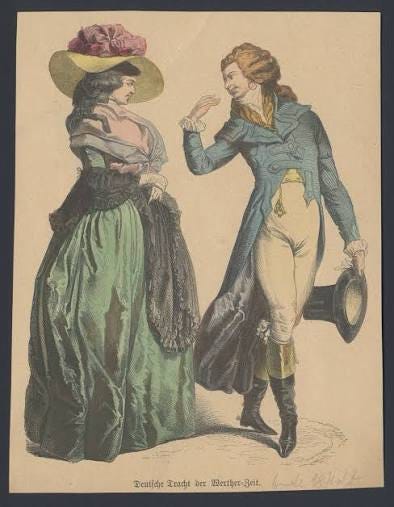
The sorrows of young Werther was one of the earliest forms of pop culture fandom I can think of. When it was released in 1774, it rapidly gained a cult following, who were then served with a number of merchandising options to fill their love for the story. Besides the most tragic results of this cult status that I don't feel the need to mention here, the young Werther was an important fashion icon that would consolidate the simplicity of menswear. The Werther look was comprised of a long blue coat, over a yellow vest paired with trousers of the same color. It was the perfect mix of a small reminiscence of the colorful French-influenced continental style and the simplicity of the English cut.
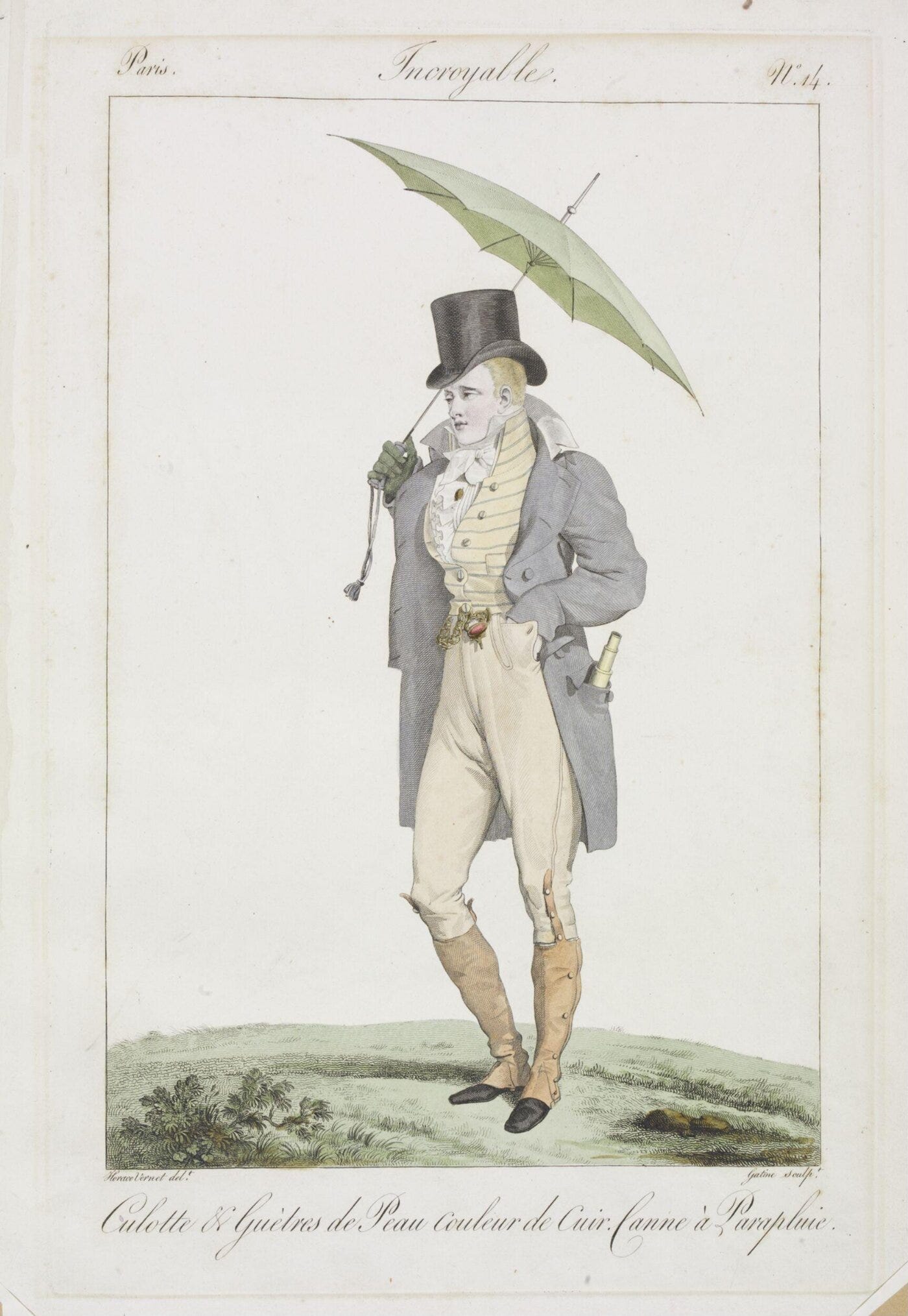
Of course, this consolidation of the English style for menswear throughout the 17th and 18th centuries wasn't linear and smooth. Some extravagant subcultures came to resist the transformation: In France we had the Incroyables, right after the French revolution, where the young men of what was left of an upper class would indulge in the excesses of fashion and decadence, in opposition to the sober enlightened man that was being created. In England we can see the Maccheroni, always to represent the English man who fell into the vices of the French, becoming extremely self-indulgent, effeminate, and a victim to extravagant fabrics, wigs and makeup. The last “cry” for a more opulent men's fashion was between the 18th and 19th centuries, with the Dandies like Oscar Wilde and others from the Aesthetic and Decadent movements, and their American counterparts, the Dudes, led by Evander Berry Wall (also known as The King of the Dudes) who promoted oversized cuts of the traditional English suit, expensive fabrics and a highly consumerist behavior based on a constant change of new pieces.
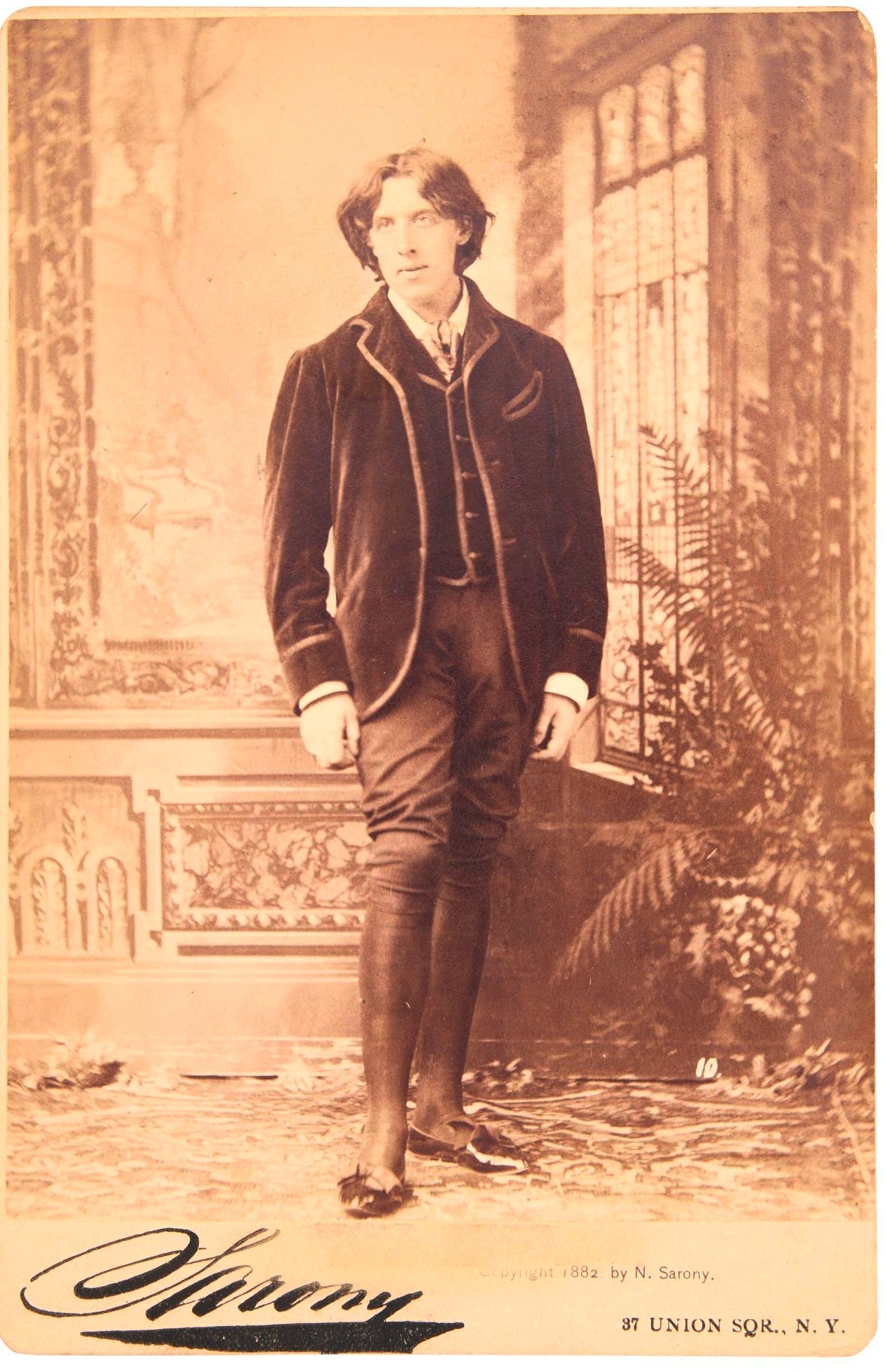
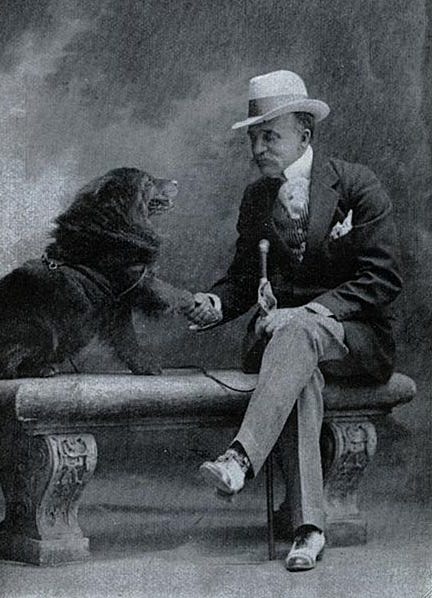
They all perished, and the sober men's style of the English took over. The industrial revolution had its role. It was the beginning of the sweating system, meaning: Exploited workers sewing from their overcrowded low-income houses or factories, lacking basic human and safety needs. As the classic style promoted by the English was simpler, it was the easiest to adapt to this new wave of mass production. It was the beginning of most of the production system we have today: Skilled artisans, tailoring the whole suit from scratch lost their space to a chain of mass production where each section was comprised of workers specialized in specific parts of the whole piece. It was when we saw the first sewing machines and instruments like the tailor’s tape.
The philosophical and political ideas behind the austere male look were now boosted by how easy it was for it to be appropriated by the new mass production.
From that point forward, the men's style was defined in western culture: simple, sober and minimal.
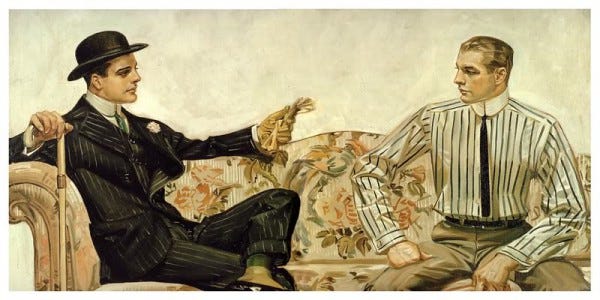
It wasn't until the 1960s that we had the first resurgence of a bit of extravagance in menswear. A movement rightfully called the Peacock Revolution, which gave back to men floral prints, bright colors, ruffles, velvet and lace, and it changed the cut to include wide leg trousers and collarless jackets. Ironically enough, this revolution also came from England, influenced by musicians related to Glam Rock. Unfortunately, it was short-lived, and the practical ‘power suit' came back. It never went anywhere, really. Because although the peacock revolution had a certain impact, it was much closer to being a subculture, rather than a unified direction for menswear in the West.
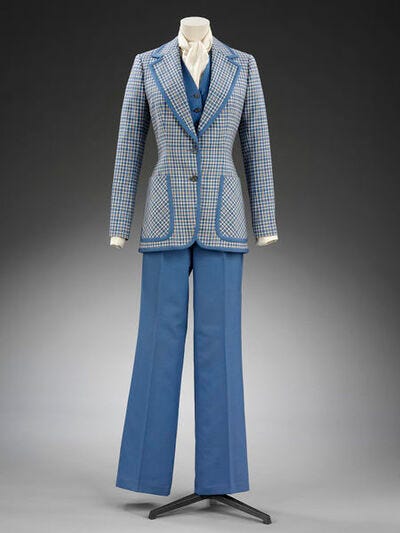
Men's fashion changed drastically since then. Suits gave way to button-down shirts with classic trousers, and then T-shirts and jeans became the main outfit for the average man who is not in corporate. But the main idea remains the same: A practical sobriety.
The search for a more curated selection of material, color and cut selection now exists only within different subcultures that follow not the canons of the Western male, but their own principles and guidelines that are often in opposition to them. The reaction to the non-traditional man today is the same as the English Puritans had in the past: effeminate, un serious, childish, unprofessional and so on. Even people from marginalized groups use this conflict to signify their position: Those who want to assimilate will often criticize those who focus on self-expression, for not following the traditional and ‘normal’ Canon, and this is not a modern dynamic either, as I mentioned here when I wrote about the 19th century anonymous gay aristocrat from Italy and his relationship to sexuality, aesthetic and the Anglomania.
Now, with the English simplicity so ingrained in western menswear, any form of extravagance or curation regarding colors, cut and textile remains in the realm of self-expression, divided by the many subcultures with their own history, philosophy and visual identity. Rejected by the mainstream, although sometimes appropriated by it. It’s a long-standing meme now on queer social media, on how straight men are copying queer fashion: pearl necklaces, crop tops, short shorts etc.
In conclusion: Not everyone had access to the extravagant style of the French court, of course. But men were not wearing plain black, grey and navy blue all the time. The desire to appear as belonging to a higher class and convey social mobility and material wealth was the leading factor for men to pay attention to their style. Today, this desire is manifested through the traditional suit as the average man now gets by with t-shirts and jeans, while the many peacock revolutions continue to happen underground.